Climate change is no longer a distant environmental issue. Across the world, countries are experiencing extreme heatwaves, floods, droughts, glacier melting, food insecurity, and rising public health risks. For Pakistan, these impacts are becoming increasingly severe. The devastating floods of 2022, prolonged heatwaves, changing rainfall patterns, and growing water stress have shown that climate change is directly affecting livelihoods, agriculture, and economic stability.
As global temperatures continue to rise and efforts to reduce greenhouse gas emissions remain slow, scientists and policymakers are increasingly discussing more radical approaches to climate intervention. One of the most debated among these approaches is Solar Radiation Management (SRM), often referred to as solar geoengineering.
Although still controversial and largely experimental, SRM is gradually moving from scientific debate into international policy discussions. For developing countries, especially those in the Global South, this emerging debate carries both opportunities and serious risks.
Understanding Solar Radiation Management
Solar Radiation Management refers to a group of proposed technologies that reflect a small portion of sunlight back into space to reduce global warming. Unlike traditional climate action, which focuses on reducing carbon emissions, SRM attempts to temporarily cool the Earth by changing how much solar energy the planet absorbs.
Scientists often compare this idea to the cooling effect observed after major volcanic eruptions. When volcanoes release sulfur particles into the upper atmosphere, these particles reflect sunlight and temporarily cool global temperatures.
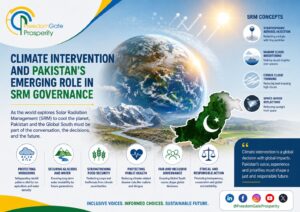
Several SRM methods are currently being studied worldwide. The most discussed is Stratospheric Aerosol Injection (SAI), which proposes releasing reflective particles into the stratosphere. Another approach is Marine Cloud Brightening (MCB), in which seawater particles are sprayed into clouds over the ocean to increase their reflectivity. Researchers are also exploring Cirrus Cloud Thinning and futuristic concepts such as space-based reflectors.
At present, no country has officially deployed SRM on a large scale in operations. However, research programs and limited experiments are already taking place in countries such as the United States, the United Kingdom, Australia, and China.
Why the World is Discussing SRM
The growing interest in SRM reflects increasing frustration with the slow pace of global climate action. Despite decades of climate negotiations, global emissions remain high while climate disasters continue to intensify.
Many scientists fear that the world may cross dangerous climate tipping points if warming continues unchecked. Rising temperatures threaten glaciers, forests, oceans, biodiversity, agriculture, and public health systems. In this situation, some policymakers and researchers view SRM as a possible emergency measure to temporarily reduce warming while emissions reductions continue.
However, most climate experts agree that SRM cannot replace climate mitigation. Reducing greenhouse gas emissions must remain the primary solution. SRM, if used, would provide only temporary relief and could introduce major environmental and geopolitical risks.
Why the Global South is Concerned
The SRM debate has major implications for countries in the Global South. Many developing nations contributed very little to historical carbon emissions, yet they are among the most vulnerable to climate impacts.
The concern is that decisions about climate intervention technologies could be dominated by wealthy industrialized countries, while developing countries may bear many of the unintended consequences.
Unlike local environmental policies, SRM could potentially affect climate systems across regions and continents. Changes in atmospheric circulation, rainfall patterns, cloud formation, and temperature distribution may influence agriculture, water resources, and ecosystems far beyond the country conducting the intervention. This is especially important for monsoon-dependent regions such as South Asia.
Why Pakistan Should Pay Attention
Pakistan is among the countries most vulnerable to climate change. The country depends heavily on the Indus River system, glacier-fed water supplies, predictable monsoon rainfall, and climate-sensitive agriculture. Even small disruptions in these systems can create serious economic and social consequences.
If SRM technologies alter regional rainfall patterns or atmospheric circulation, Pakistan could face impacts on agriculture, water availability, glacier behavior, public health, and disaster risks. Pakistan’s agriculture relies heavily on stable seasonal patterns. Crops such as wheat, rice, cotton, and sugarcane are highly sensitive to changes in rainfall and temperature. Any major shifts in monsoon timing or precipitation could directly affect millions of livelihoods.
Similarly, Pakistan’s glaciers in the Himalaya, Karakoram, and Hindu Kush regions are critical for long-term water security. Scientists still do not fully understand how large-scale climate intervention could influence glacier accumulation, snowfall patterns, and seasonal melt cycles.
Public health is another important concern. Climate conditions directly affect diseases such as malaria and dengue. Changes in temperature, humidity, and rainfall may influence mosquito habitats and disease transmission patterns across South Asia.
Pakistan’s Emerging Role in SRM Governance
Although Pakistan is not conducting operational SRM experiments, the country has already begun participating in important research and policy discussions on climate intervention governance.
Recently, COMSATS University Islamabad organized discussions and workshops focusing on climate intervention, SRM governance, and health-related implications. These discussions examined the relationship between climate change, SRM, and disease patterns such as malaria transmission. Researchers and experts also explored the ethical, environmental, and policy dimensions of geoengineering technologies.
This is an important development because it signals that Pakistan is beginning to recognize SRM not only as a scientific issue, but also as a governance, public health, and national security issue. Pakistan’s participation is particularly important because countries most vulnerable to climate change should not remain absent from discussions that could potentially reshape global climate systems.
The Governance and Ethical Challenge
One of the biggest concerns surrounding SRM is the absence of a clear international governance system. Important questions remain unanswered. Who decides whether SRM should be deployed? Can one country act alone? Who will monitor global impacts? What happens if one region benefits while another suffers?
These are not only scientific questions. They are ethical, political, and geopolitical questions.
Many experts fear that if SRM technologies advance without strong international oversight, they could increase global tensions and inequalities. Climate intervention could become a source of political conflict between countries with different environmental and economic interests.
For developing countries, participation in governance discussions is therefore essential. Pakistan, along with other Global South countries, has a strong interest in advocating for transparent international oversight, scientific cooperation, regional climate assessments, ethical safeguards, and inclusive decision-making mechanisms.
The Need for Balanced Public Dialogue
It is important to approach SRM with balance and caution. The topic often generates emotional reactions, misinformation, and conspiracy theories. Public discussions should remain grounded in scientific evidence and responsible climate communication.
At the same time, ignoring SRM discussions would also be unwise. Research is already advancing internationally, and future climate emergencies may increase pressure on governments to consider unconventional interventions.
Pakistan, therefore, needs informed public dialogue involving climate scientists, universities, policymakers, civil society, media professionals, and regional institutions. Building local scientific capacity and public understanding will help Pakistan better assess future risks and opportunities.
Why Pakistan’s Voice Matters
Solar Radiation Management remains one of the most controversial and uncertain areas of climate science. While some view it as a potential emergency response to escalating global warming, others warn that it could create dangerous environmental and geopolitical consequences.
For Pakistan, the issue is particularly important because of the country’s dependence on monsoons, glaciers, agriculture, and climate-sensitive livelihoods. Even if Pakistan never deploys SRM technologies itself, it could still experience the consequences of decisions made elsewhere.
This is why Pakistan’s emerging participation in SRM governance discussions matters. The country has an opportunity to contribute as a responsible voice from the Global South, advocating for climate justice, scientific transparency, ethical governance, and inclusive international cooperation.
As climate challenges intensify, one thing is becoming increasingly clear: countries most vulnerable to climate change must also play a meaningful role in shaping the future of climate intervention governance.
——–
Muhammad Anwar is the Founder and CEO of Freedom Gate Prosperity (FGP). With over 33 years of experience in development and public policy, he writes and speaks on climate governance, civic engagement, and sustainable development. He can reach out to ceo@fgp.org.pk