
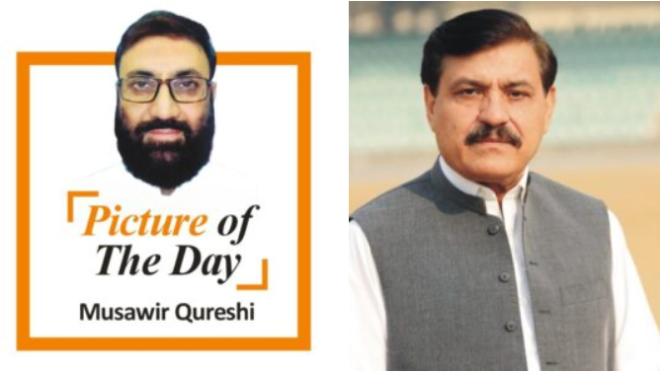
By: Musawir Qureshi
In this day and age, practicing journalism—and doing it with true integrity—is like chewing iron pellets. This is because when you speak the truth, you not only face the threat of casualties, violence, and other hardships, but you also sometimes lose your livelihood. On the other hand, those with a conscience cannot practice the journalism of lies, and those who do practice it are completely foreign to the concept of conscience. Journalism is not merely a business; it is a mission, a responsibility, and a testament to sacrifice. In this field, only those succeed who rise above their personal interests and prioritize collective public service. Furthermore, when journalism intersects with the political arena, it becomes an even more daunting task.
However, the personality I am speaking of has carved out a distinct and unique position for himself in the history of journalism in Peshawar, securing a permanent place in the hearts of journalists. Do you know who this personality is? He is M. Riaz. He is not only a senior journalist but is widely counted among the most successful presidents in the history of the Peshawar Press Club. M. Riaz has won the Peshawar Press Club elections multiple times with an overwhelming majority. This success is not the result of backing by any powerful faction or group; rather, it is the fruit of his selfless service, sincerity, unwavering honesty, and true dedication and love for working journalists. In the history of the Peshawar Press Club, it is incredibly rare to find another example of an individual being continuously granted such deep trust and affection as M. Riaz Sahib has received.
His greatest virtue is that whenever he is in power, he dedicates more time to the journalist community than to himself or his own family. Be it day or night, freezing cold or scorching heat, if any journalist faces trouble, M. Riaz Sahib is ready to help at a moment’s notice. Whether it is a matter involving a police station, the arrest of a journalist colleague, the need for medical treatment at a hospital, or supporting a grief-stricken family, M. Riaz Sahib is always standing on the front lines. This is precisely why journalists from different factions and varying ideologies within the Peshawar Press Club hold him in high regard. He has always served working journalists by rising above factional politics. This is the true secret of his power and widespread popularity. He is not a leader who only becomes active during election days; instead, he remains present among the journalists twelve months a year.
Under the leadership of M. Riaz Sahib, the Peshawar Press Club has established a distinct identity for itself not only in Khyber Pakhtunkhwa but across all of Pakistan. His leadership has played a pivotal role in organizing Press Club activities, driving journalists’ welfare initiatives, resolving deep-seated issues, and elevating the honor and prestige of the institution. He has proven that if a leader is sincere, an institution ceases to be a mere structure of bricks and stones and transforms into a family.
The working members of the Peshawar Press Club are fortunate to have found a personality like M. Riaz Sahib, who stands firmly by their side in every difficult time. Humility, sincerity, empathy, and all the finest qualities of leadership are embodied within him. For journalists, he is not just a president—he is a guardian, a friend, and a brother. In today’s era, when most people use official positions for personal gain, M. Riaz promotes the interests and dignity of journalists over his own. Therefore, we can proudly declare that Riaz Sahib is a shining example of service, sacrifice, and loyalty. Because of this, he is viewed with immense respect and honor among journalists, not just in Peshawar, but throughout the entire country. If anyone writes the history of the Peshawar Press Club in the future, the name of M. Riaz will be included among those who gave this institution a new name and identity through their hard work, sincerity, and love for working journalists. Such people are the true assets of institutions, and their services will always be remembered.
